
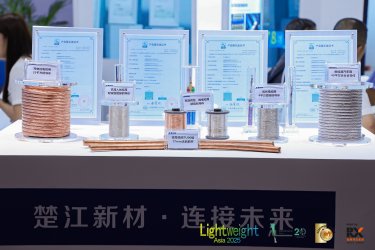
Electric vehicles that rarely need charging, drones delivering across cities, humanoid robots working 24/7—behind these scenarios, two “new materials” are quietly powering innovation: a safer battery and a smarter copper cable. Though they belong to energy and digital infrastructure respectively, together they outline one of the most promising industrial landscapes.
Solid-State Batteries: Breakthroughs in Safety and Energy Density Open New Possibilities
Traditional lithium batteries face risks of thermal runaway due to liquid electrolytes, with energy density struggling to exceed 400 Wh/kg. Solid-state batteries replace liquid electrolytes with solid ones, reducing thermal runaway risk by 90% and breaking energy density limits. This transformation is essentially a reconstruction of the material system.
Three Core Material Innovations:
· Sulfide Solid Electrolytes: Room-temperature ionic conductivity reaches 10⁻³ S/cm, with strong chemical stability. They can directly contact lithium metal, solving the “dendrite growth” problem. Leading domestic companies have produced ultra-thin (5 μm) electrolyte films at pilot scale, with ion transport efficiency approaching that of liquid electrolytes.
· Composite Lithium Metal Anodes: Nanostructured silicon-carbon coatings encapsulate lithium metal, suppressing dendrites and extending cycle life from 500 to over 2,000 cycles, ensuring stable charge-discharge performance.
· Interface Modifiers: By combining polymers or ceramic particles, the contact between solid electrolyte and electrodes improves, raising energy density by an additional 15%.
Emerging Application Scenarios:
In electric vehicles, some pilot solid-state batteries achieve 1,000 km range without extra cooling. In low-altitude logistics, drones extend flight from 2 hours to 8 hours, with a 30% payload increase. Consumer electronics and robotics hold even greater potential—flexible solid-state batteries could make foldable phones 30% thinner and humanoid robot joint modules 40% more compact.
Copper Cables: High-Speed Connectivity as the “Digital Nervous System”
AI models and 8K video demand data center transmission speeds from 10 Gbps up to 400 Gbps. Traditional optical fibers face high latency and cost, while copper cables, with “low latency + low cost + high compatibility,” are essential for short-distance interconnects.
Three Key Material Advancements:
· High-Purity Oxygen-Free Copper: Purity ≥99.99%, conductivity 102% IACS, with 40% lower signal attenuation than ordinary copper—ideal for short-range high-speed connections.
· Electroplated Tin Coating: Replacing traditional hot-dip plating, the precise 3–5 μm coating prevents “tin whisker” shorts, raising yield from 85% to 95%.
· Beryllium Copper Alloy: 0.2–0.6% beryllium, elastic modulus 128 GPa, fatigue-resistant, capable of 100,000 insertions, maintaining stable connections under high-frequency vibration—dubbed the “steel warrior” of connectors.
Demand Surge Driven by Material Upgrades:
In 2023, the global high-speed copper cable market grew 35%, with 80% of demand from data center expansion. Domestic companies have overcome 200G/400G technical barriers, raising international cloud provider certification rates from 45% to 70%. Under China’s “East Data, West Computing” initiative, domestic consumption could exceed 3 million km in 2024, driving copper demand up by more than 150,000 tons.
Dual-Engine Future: How New Materials Anchor Tomorrow
Solid-state batteries solve the energy challenge of “long-lasting and high-range,” while copper cables tackle the digital bottleneck of “fast and stable transmission,” jointly forming an “energy + data” ecosystem.
In the future, low-altitude aircraft will rely on solid-state batteries for power and copper cables for flight control data. Humanoid robots will depend on solid-state batteries for operation and copper cables for sensor-actuator connectivity. Foldable phones and smart appliances will become thinner, lighter, and smarter.
Two signals are crucial at this critical point of industrial transformation:
· Pilot-Scale Breakthrough in Solid-State Batteries: Announcing “1,000 km-range EV testing” marks material system maturity and the start of industrialization.
· Ongoing Material Innovation: This wave is reshaping the new energy and digital infrastructure landscape and will permeate daily life—soon, drones will fly farther, robots will understand us better, and phones may charge in 5 minutes. All of this lies hidden in the microstructure of solid-state electrolytes and the high-speed vibrations of copper cables.
Source:Changjiang Nonferrous Metals Network